IoT Data Hub · Data Foundation
Connect machine data once. Reuse it in a controlled manner.
A robust data foundation is essential for dashboards, analytics, AI notebooks, and AI pipelines. Bytefabrik integrates machine data from various protocols, standardizes it, and makes it available in a controlled manner for further applications.
Part of the IoT Data Hub
Diese Fähigkeit arbeitet auf derselben Konnektivität, Semantik, Historie und Governance wie alle Data-Hub-Werkzeuge.
When Every New Machine Becomes Yet Another Integration Project
Connectivity can only serve as a solid foundation when technical connectivity, business context, and rollout are addressed together.
- 01
Protocols and generations of machines differ
Control systems, sensors, and existing systems provide data via different interfaces, structures, and update rates.
- 02
Raw signals lack technical context
A value becomes usable only when it has been reliably assigned to a unit, facility, station, process step, and meaning.
- 03
A successful pilot program can't simply be copied
Manual configurations and custom mappings prevent additional machines or lines from being connected in a controlled manner.
- 04
OT networks require flexible operating models
Segmentation, limited connectivity, and data sovereignty require edge, on-premises, and distributed deployment options.
From Data Source to Reusable Data Product
The IoT Data Hub does more than just connect machines. It brings together connectivity, harmonization, context, and future use within a single, integrated model.
- 01
Data Source
Connect controllers, sensors, gateways, and existing systems.
S7 · OPC UA · MQTT · IO-Link · REST
- 02
Connection
Capture signals, verify them, and transmit them securely to the platform.
Edge · On-Premise · Centrally Managed
- 03
Harmonization and Context
Transform data and map assets, units, and semantics.
Mappings · Assets · Metadata · History
- 04
Data product
Reuse the same data source for dashboards, analytics, APIs, and AI.
Charts · AI Notebooks · AI Pipelines · Insights
Data Onboarding as a Controlled Product Workflow
The product views show how an industrial source is built, from the initial connection to the reusable rollout model.
How does a machine connection become a scalable data product?
Configure an Industrial Connection (Guided)
Adapters guide users through connection parameters, security, and the selection of relevant signals. Existing industrial protocols can be configured without the need for a custom integration interface.
OPC UA · MQTT · S7 · Modbus · IO-Link · REST
Understanding Platform Architecture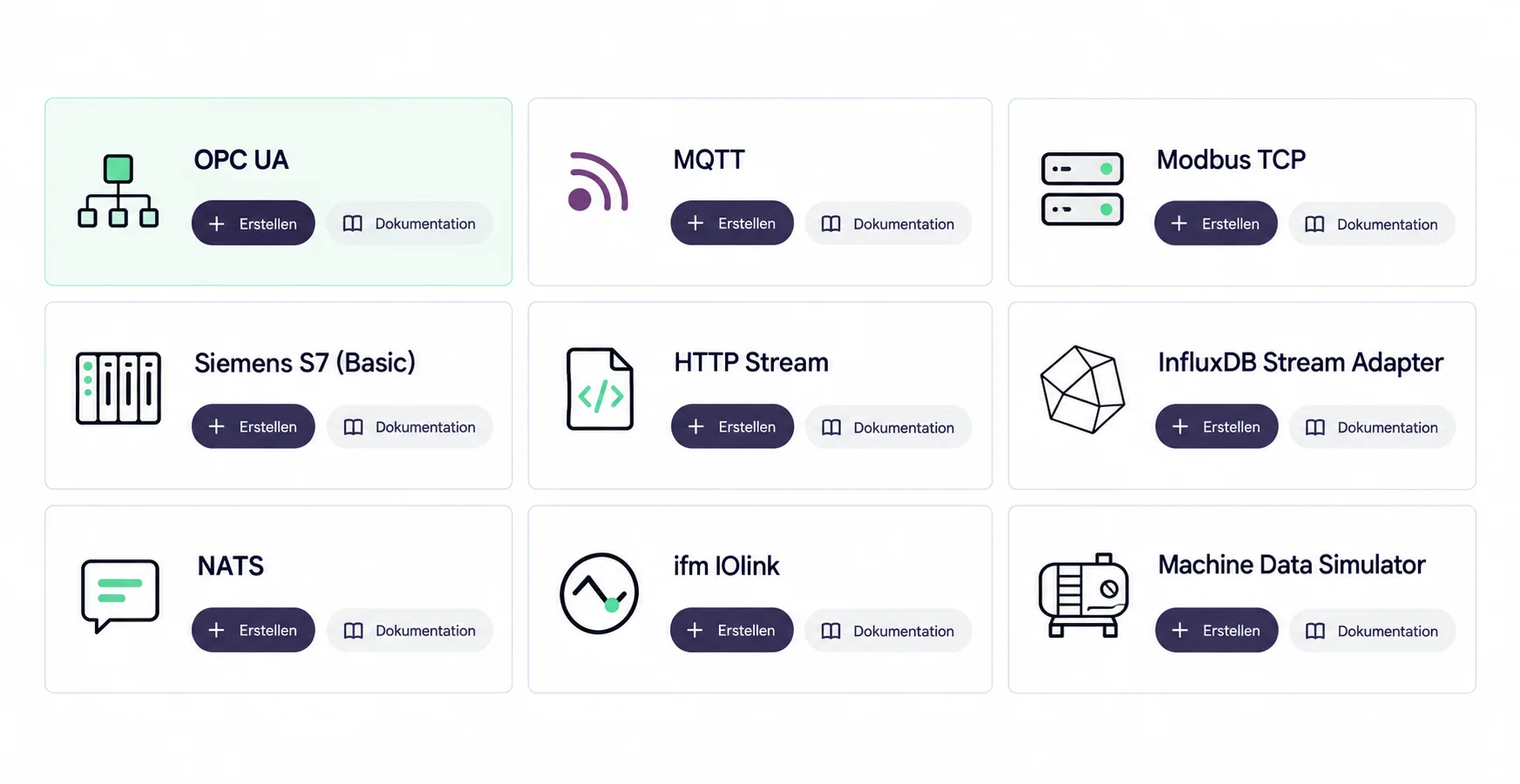
What turns a connection into a robust data foundation.
Industrial Connectivity
Open protocols and adapters for controllers, sensors, and existing systems.
Semantic Context
Assets, units, and metadata give each signal a reusable meaning.
Controlled Operation
Roles, versioning, and traceable changes for production environments.
Repeatable Rollout
Templates and remote deployment for machines, production lines, and multiple locations.
Open to Applications
Provide the same data source for dashboards, analytics, APIs, and AI.
From the first adapter to full rollout
The expansion relies on reusable structures rather than constantly creating new, standalone integrations.
- 01Pilot
Connect a relevant data source
Connections, signals, and the technical target context are validated on a specific machine.
- 02Template
Making the Configuration and Model Reusable
Proven parameters, mappings, and asset structures are saved as controlled templates.
- 03Line
Roll out the same machine types consistently
Templates speed up additional connections and reduce discrepancies between installations.
- 04Multi-Site
Manage locations centrally, operate them locally
Distributed instances, roles, and deployments create a common framework for the full rollout.
Frequently Asked Questions About Architecture
Does the connectivity fit into our OT and IT environments?
Does production data have to leave the factory?
No. Connections and data processing can be handled close to the edge or entirely on-premises. Centralized or cloud-based components are only used where architecture and governance permit.
Do existing systems need to be replaced?
No. The IoT Data Hub connects control systems, gateways, historian systems, and line-of-business applications and presents their data in a unified context.
How are proprietary data sources integrated?
In addition to existing adapters, proprietary sources can be integrated via open APIs and the Developer SDK. The new connection then uses the same models and operating mechanisms.
How does a pilot program become a resilient rollout?
Configurations, mappings, and asset models are reused as versioned templates. Remote deployment and centralized governance reduce the manual effort required for additional machines and locations.
30-minute product demo
Which machine would you like to connect first?
We'll demonstrate live how a specific data source is connected, harmonized, and made available for dashboards, analytics, and AI. A concise session that requires no preparation.
Product demo with a specific data source