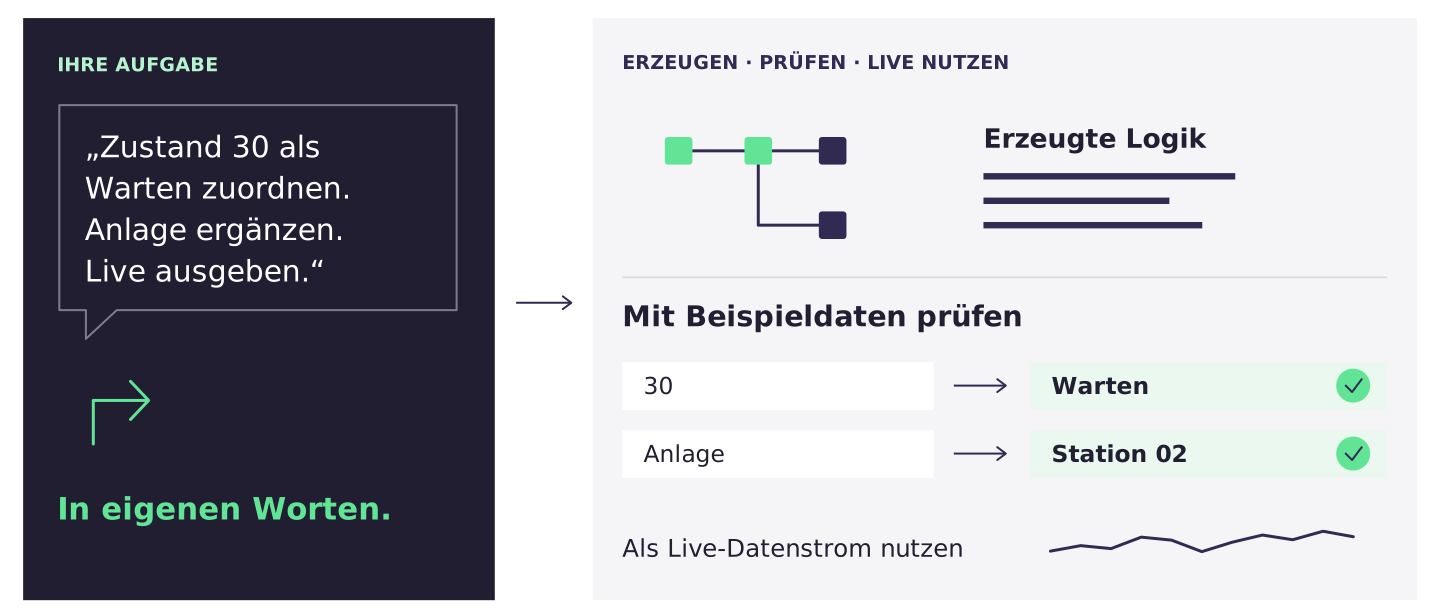
01Describe
Formulate the required live analysis in technical terms
Users describe which signals are to be synchronized, monitored, or analyzed. The task thus remains focused on the production requirements rather than on available components.
IoT Data Hub · Real-Time Analysis
AI pipelines define data analyses on live streams of machine data. Instead of simply connecting graphical blocks, more complex monitoring and data harmonization tasks can be generated using natural language as explainable code.
Diese Fähigkeit arbeitet auf derselben Konnektivität, Semantik, Historie und Governance wie alle Data-Hub-Werkzeuge.
AI pipelines bridge the gap between understandable business requirements and controlled, real-time analysis.

Multi-level harmonization, monitoring, or pattern recognition can quickly become confusing in purely graphical models.
Code outside the data platform is difficult to test collaboratively, version control, and reuse for other data streams.
Without appropriate test data and a visible execution, errors often remain hidden until the system is deployed with real machine data.
Results must be available as live data again so that other pipelines, data sinks, or notifications can respond to them.
Choosing the Right Modeling Approach
Reusable standard logic remains easy to navigate in the graphical editor. AI pipelines extend the workflow with explainable code for more complex live analyses and harmonization steps.
Request a 30-minute demo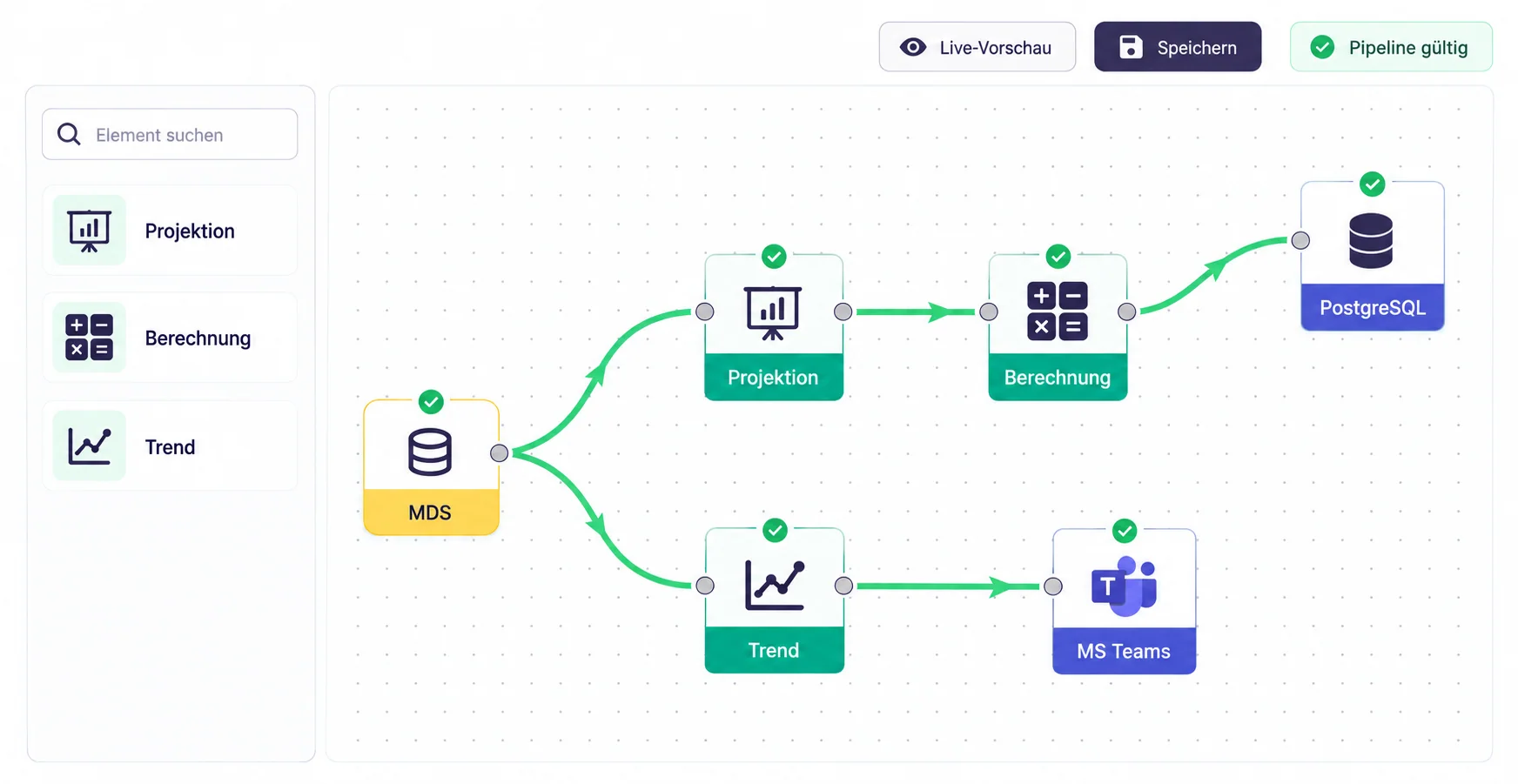
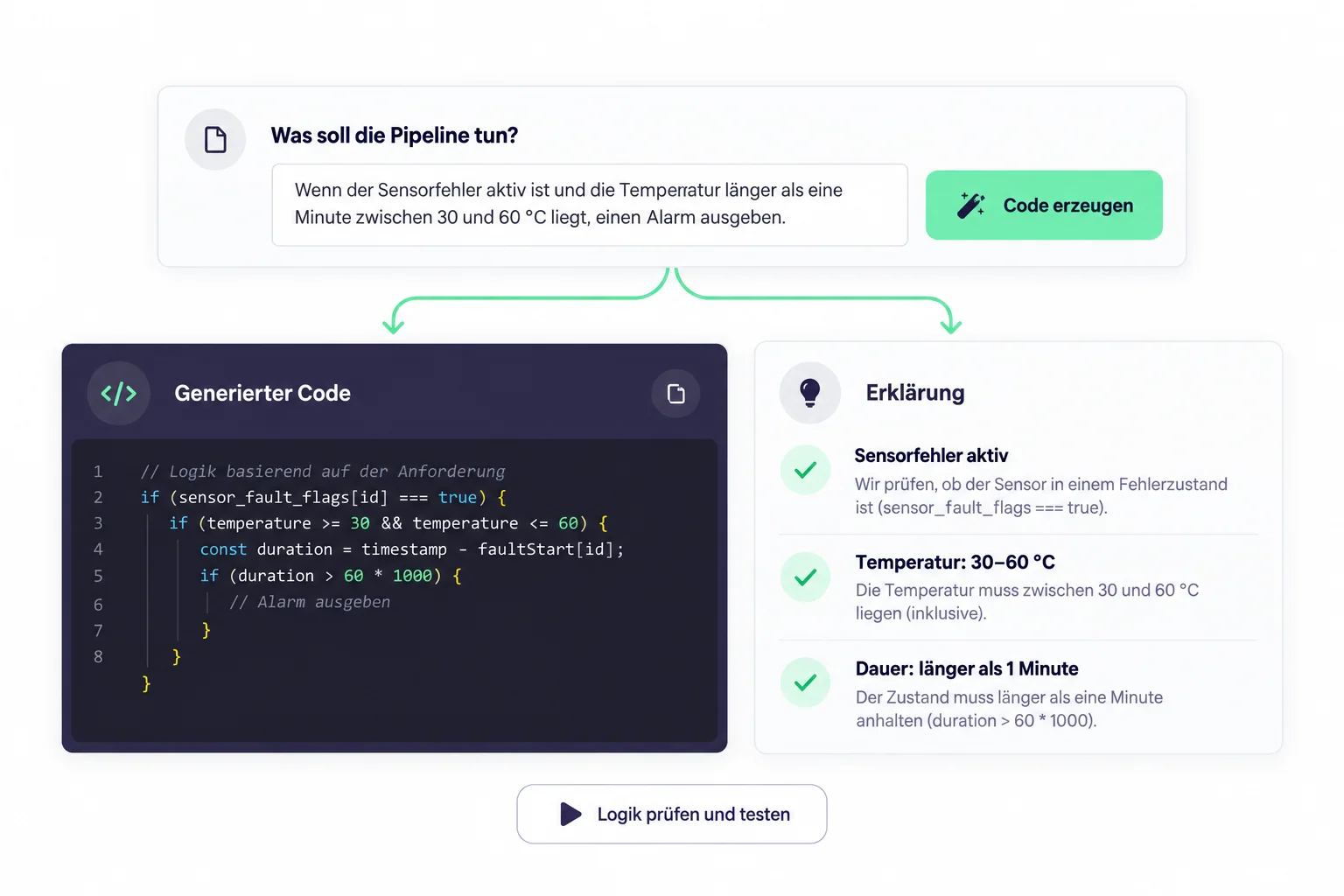
Users describe which signals are to be synchronized, monitored, or analyzed. The task thus remains focused on the production requirements rather than on available components.
The generated code remains visible, can be explained, and can be checked or modified before execution. This prevents the creation of a hidden "black box" for analysis.
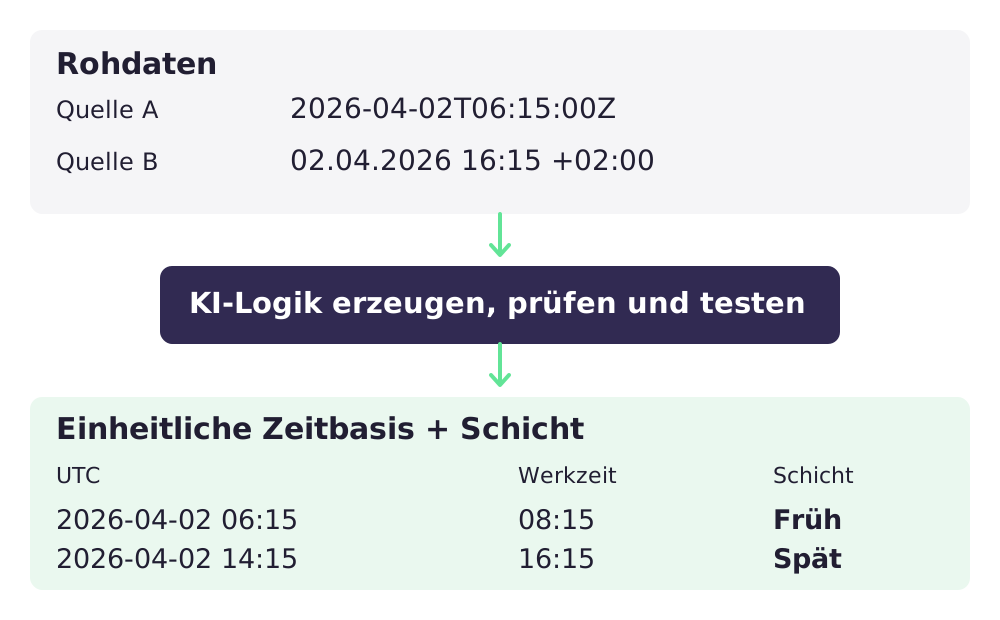
Test data helps verify behavior and output before deployment in a production environment. Adjustments remain part of the same traceable workflow.
The analysis being performed continuously generates new data streams. These can be stored, visualized, or used by other pipelines and actions.
From the technical definition to feeding the results back into ongoing data streams.
Describe complex live monitoring and data harmonization as technical requirements.
Keep generated code visible, explain it, check it, and modify it before execution.
Continuously perform analytical logic on high-frequency machine data.
Provide results as new live data streams for visualization, storage, and actions.
Installation and Operation
No. Graphical pipelines remain the primary approach for reusable standard building blocks. AI pipelines complement them in cases where an analysis or harmonization would be too rigid or too complex as a graphical model.
Yes. The code remains visible, can be explained and customized, and can be tested with test data before it is run on live production data streams.
The actual live data does not need to be transferred to the language model. The model supports code generation; data access and execution take place in a controlled manner within the platform architecture.
AI notebooks are suitable for exploratory queries on stored data. AI pipelines are designed for continuous harmonization, monitoring, and analysis of live data streams.
30-minute product demo
We'll show you how a technical specification can be turned into understandable code, a validated test, and a live data stream in production.
Product demo with a specific live data scenario